
How to Reduce No-Shows at Your Restaurant
No-shows are one of the most frustrating parts of running a restaurant. A guest books a table, you prepare for them, and they never walk through the door. No call. No text. Just an empty table during your busiest hours.
This guide covers practical strategies that work. Most of them take minutes to set up. Together, they can cut your no-show rate in half.
What no-shows actually cost you
A single no-show might seem minor. But the costs add up fast.
Lost revenue. An empty four-top during Saturday dinner is $150 to $300 you will never get back. If you average two no-shows per night, that could be $3,000 to $6,000 per month walking out the door.
Wasted food prep. Your kitchen preps based on expected covers. When those guests never show, you are left with food that may not sell. For restaurants with prix fixe menus or special event sittings, the waste is even worse.
Staff scheduling. You scheduled servers, bussers, and kitchen staff based on your reservation count. No-shows mean you are overstaffed for actual demand. You are paying people to stand around.
Turned-away guests. This is the hidden cost. While that no-show table sat empty, you may have told walk-ins or callers that you were fully booked. You lost revenue twice.
The industry average no-show rate sits between 10% and 20%. For a restaurant doing 50 covers a night, that is 5 to 10 empty seats every single service. Over a year, that adds up to tens of thousands of dollars.
Why guests no-show
Understanding why helps you pick the right fix.
They forgot. Life gets busy. A reservation made on Monday for Friday dinner can easily slip someone's mind. This is the most common reason, and the easiest to fix.
They double-booked. Some guests book at two or three restaurants and decide last minute. They cancel the ones they skip (or more often, they just do not bother).
There are no consequences. If a guest can no-show without any friction, some will. When there is nothing on the line, canceling feels optional.
Canceling feels like a hassle. Surprisingly, many no-shows happen because guests wanted to cancel but did not want to make an awkward phone call. If the only way to cancel is calling during business hours, some people will just skip it.
Strategy 1: Send automated reminders
This single change reduces no-shows by 30% to 40%. It is the highest-impact thing you can do.
Most no-shows are people who simply forgot. A reminder the day before (and another a few hours before) brings the reservation back to the top of their mind. They either show up or cancel with enough time for you to fill the table.
How it works with bavoli:
When a guest books through your bavoli booking page, they automatically receive:
- An instant confirmation right after booking
- A reminder the day before their reservation
Both go by email on every plan, and by text to guests who gave a mobile number, within your plan's monthly allowance of texted parties (the first 25 parties on the Free plan). You do not need to send any of these manually. bavoli handles it once you turn on online reservations.
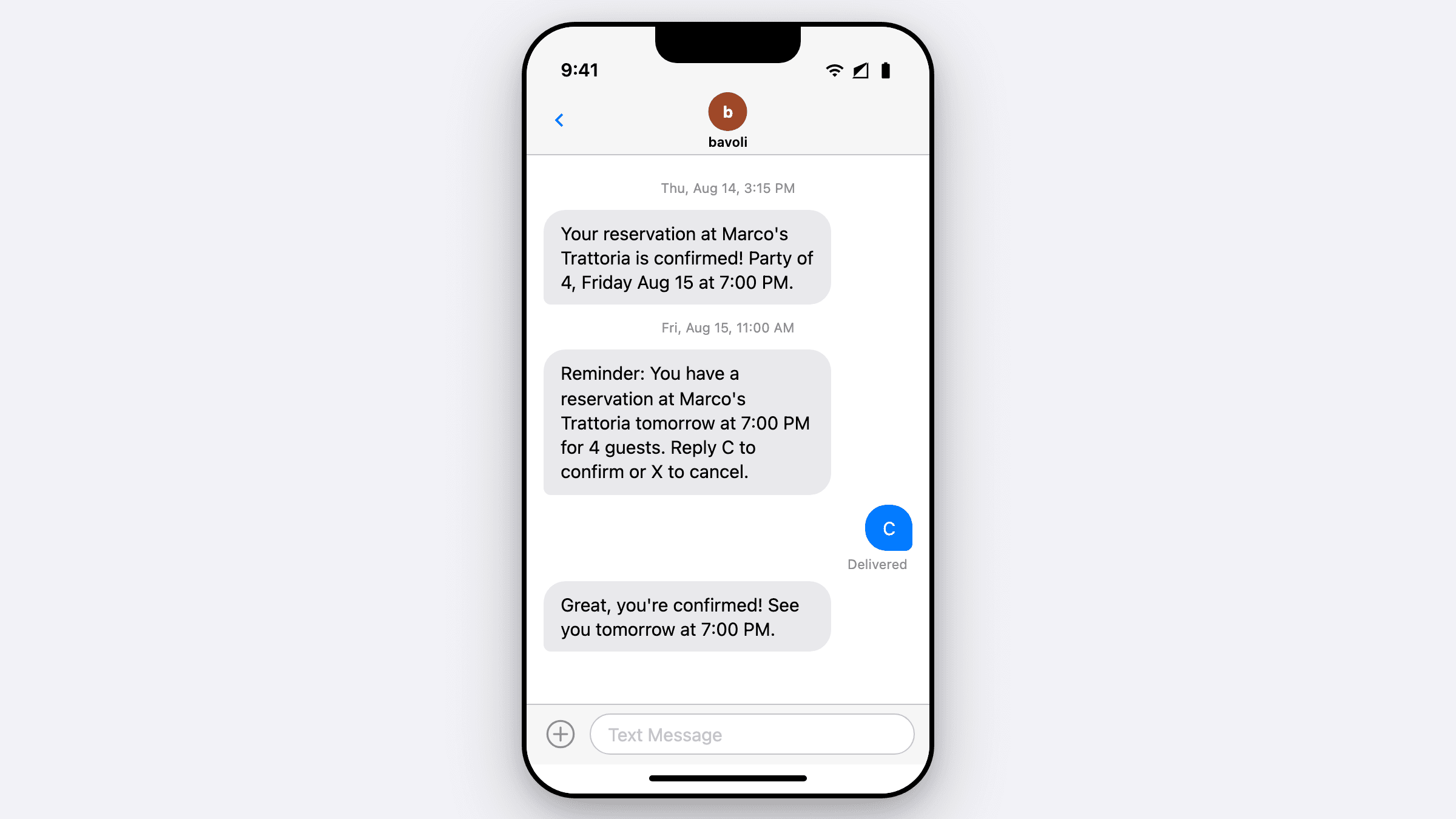
Each reminder includes the date, time, party size, and your restaurant name. Guests can confirm or cancel with a single tap right from the message.
Strategy 2: Make canceling easy
This sounds counterintuitive. Why would you make it easier for people to bail?
Because a cancellation is always better than a no-show. When someone cancels, even at the last minute, you get that table back. You can seat a walk-in, call someone from the waitlist, or adjust your prep. A no-show gives you nothing.
The harder it is to cancel, the more no-shows you get. If a guest has to call during business hours and explain themselves to a host, many will just skip it entirely.
How it works with bavoli:
Every confirmation and reminder message includes a one-tap cancel button. The guest taps it, the table opens up immediately, and your availability updates in real time.
No phone call. No awkward conversation. The guest does the right thing because you made the right thing easy.
Strategy 3: Fill canceled tables from your waitlist
Cancellations hurt less when you can fill the table quickly. A waitlist turns cancellations from lost revenue into recovered revenue.
How it works with bavoli:
- Guests who cannot find an open slot can join your waitlist for that date and time
- When a reservation gets canceled, bavoli automatically notifies the next person on the waitlist by SMS
- The waitlist guest can claim the table with one tap
- The table goes from canceled to re-booked in minutes
This works especially well on busy nights. Friday and Saturday waitlists often have several people ready to grab any opening. The faster you notify them, the more likely they are to take the spot.
Without a digital system, backfilling from a waitlist means flipping through a notebook and making phone calls. By the time you reach someone, the window has often closed.
Strategy 4: Hold a card with a no-show fee
For everyday two-tops and four-tops, reminders and easy cancellation handle most no-shows. But large parties and special events need stronger protection.
A party of 8 that no-shows can cost you $500 or more in a single evening. For those high-stakes reservations, a card-on-file requirement changes the math for the guest.
How it works with bavoli (Plus and Pro plans, from $30 a month):
- Turn on Require Card on File in your no-show settings
- Set a no-show fee, or set it to 0 if you only want the card as a deterrent
- Guests enter a card and agree to your policy when they reserve, and a temporary hold for the fee is placed on it
- The hold is released when they arrive and charged only if they miss the reservation
Most guests understand this. Card holds are common at higher-end restaurants, and they signal that you take your reservations seriously.
Important: Be clear about your policy when guests book. bavoli shows the no-show fee on the booking screen so there are no surprises.
Strategy 5: Track repeat offenders
Some guests no-show once. Others make a habit of it. Knowing the difference lets you make better decisions.
How it works with bavoli:
bavoli tracks every guest's reservation history. When a guest with previous no-shows makes a new reservation, you will see a flag on their booking.
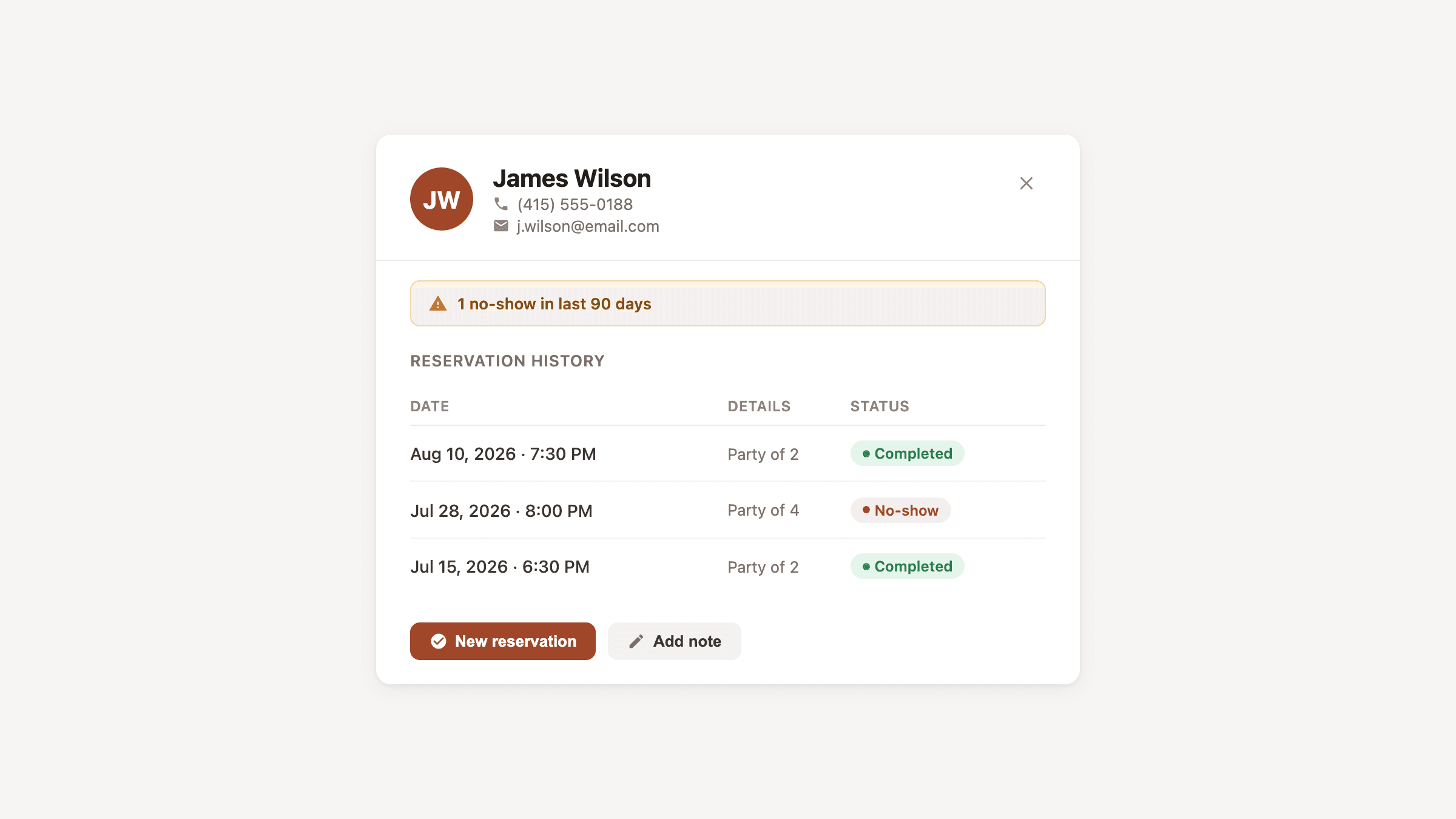
What you do with this information is up to you:
- Call to confirm the day before if a flagged guest has an upcoming reservation
- Prioritize other guests for limited availability on your busiest nights
You are not punishing anyone. You are protecting your business using real data about guest behavior.
With a paper notebook, this kind of tracking is nearly impossible. You would need to remember every guest who did not show up over months or years. A digital system does it automatically.
What actually works: combine multiple strategies
No single strategy eliminates no-shows entirely. The restaurants with the lowest no-show rates use several of these together.
Here is a practical starting point:
- Turn on automated reminders. This alone cuts no-shows by a third. It takes five minutes to set up, and email reminders are free on every plan.
- Enable one-tap cancellation. Let guests do the right thing easily. Pair this with your waitlist so canceled tables get filled.
- Activate your waitlist. Even a short waitlist on busy nights recovers revenue from cancellations.
- Hold a card on file. On Plus or Pro, a no-show fee on the card turns an empty table into money back.
- Review your no-show data monthly. Look at which nights and times have the highest rates. Adjust your policies for those specific slots.
Most restaurant owners who switch from a paper notebook to bavoli see their no-show rate drop within the first two weeks. The combination of reminders, easy cancellation, and waitlist backfill handles the majority of cases without any extra work on your part.
You have already done the hard part of building a restaurant people want to visit. These strategies make sure the guests who book actually show up.


