Your Instagram Has Thousands of Followers. Why Aren't They Booking?
A guest finds your restaurant on Instagram. They scroll through your feed, watch a reel of your pasta being plated, and think: I want to eat there.
Then what?
They tap the link in your bio. It goes to your website. They look for a way to book. Maybe there's a phone number. Maybe there's a contact form. Maybe there's a Linktree with six options and none of them say "reserve a table."
They close the app. They forget. They eat somewhere else.
This happens constantly. And it happens because most restaurants treat Instagram as a place to post rather than a place to convert.
Instagram is a restaurant discovery engine
This isn't speculation. Toast's restaurant social media study found that 19% of guests use Instagram as their primary tool for finding new restaurants. Among guests under 18, that number jumps to roughly 40%. Among guests 18 to 34, it's 27%.
A separate survey by MGH (1,069 U.S. adults, 3% margin of error) found that 45% of diners have tried a restaurant for the first time specifically because of a social media post. Not a recommendation from a friend. Not a Google search. A post.
74% of diners who actively follow restaurants on social media say they're more likely to visit or order from those restaurants.
So the audience is there. The intent is there. The question is whether you're giving them a way to act on it.
The bio link is your front door
Instagram gives you exactly one clickable link. One. Everything you post, every reel, every story highlight, every tagged location funnels attention toward your profile. And your profile funnels attention toward that single link.
Most restaurants waste it.
I've looked at hundreds of restaurant Instagram profiles. The link goes to a homepage with no clear booking path. Or it goes to a Linktree. Or it goes to a menu PDF. Or it goes to a Yelp page, which means you just sent a potential guest to a platform where they'll see your competitors listed right next to you.
The restaurants that convert followers into guests do something different. They put a direct booking link in their bio. One tap, and the guest is looking at available times.
Presentation matters more than you think
Instagram is a visual platform. The people on it care about aesthetics, about how things look and feel. That's why they're there instead of reading Yelp reviews.
Your bio link is part of your presentation. It communicates something about your restaurant before the guest even taps it.
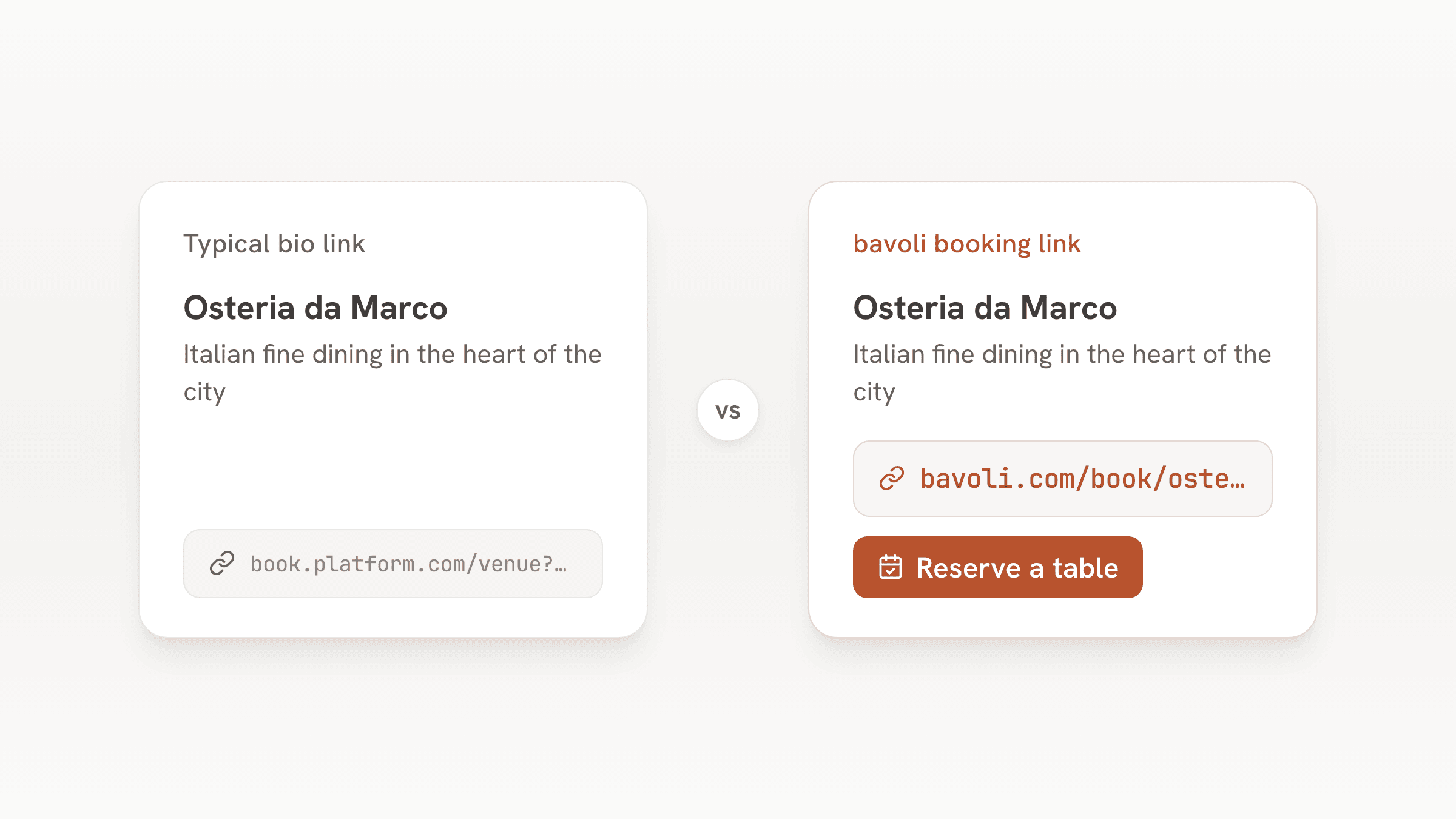
Compare these two links in a bio:
`book.someplatform.com/venue?id=8f3a2c&ref=ig_bio&utm_source=instagram`
versus
`bavoli.com/book/osteria-da-marco`
The first one looks like it was generated by a machine. The second one has your restaurant's name in it. One feels like a transaction. The other feels like an invitation.
It's a small thing. But on a platform where presentation is everything, small things compound. A clean, branded URL tells a guest that the experience they're about to have has been thought through. It matches the energy of the food photos they just scrolled past.
What happens after they tap
A booking link only works if what's on the other side is just as clean. The guest taps your link and they should see available dates, available times, and a way to confirm. Not a homepage they have to navigate. Not a phone number they have to call during business hours. Not a form that says "we'll get back to you."
The conversion path should be: see the post, tap the bio, pick a time, confirm. Three taps from discovery to reservation. Anything longer and you're losing people at every step.
This matters more on mobile, which is where virtually all Instagram traffic comes from. If your booking flow isn't built for a phone screen, it doesn't matter how good your content is.
Google is now indexing Instagram content
Here's something most restaurant owners don't know yet: as of 2025, Google indexes Instagram posts and reels. That means when someone searches "best brunch in [your city]," your Instagram content can appear in Google's results.
This changes the math. Your Instagram isn't just reaching your followers anymore. It's reaching anyone searching for restaurants in your area. And if that content leads back to a profile with a direct booking link, you've just turned a Google search into a reservation without the guest ever visiting your website.
The restaurants that will benefit most from this are the ones that already have the path in place: good content, a clear bio link, and a booking page that works on mobile.
What to actually do
Put a direct reservation link in your bio. Not your homepage. Not a Linktree. A link that takes someone straight to your booking page. If your current reservation system doesn't give you a clean, shareable URL, that's a problem worth solving.
Make the link readable. Generic tracking URLs and long parameter strings look sloppy in a bio. A short, branded URL with your restaurant's name in it looks intentional.
Add a call to action in your bio text. Something simple: "Reserve a table" with a down arrow pointing to the link. Don't assume people will find it on their own.
Mention the link in your content. When you post a reel of tonight's special, end the caption with "link in bio to reserve." When you post a story, use the link sticker. Make the connection between your content and the booking path explicit and repeated.
Check it on your phone. Open your own Instagram, tap your own bio link, and try to book a table. If it takes more than 30 seconds or requires pinch-zooming, fix it.
bavoli gives every restaurant a booking page at a clean URL: `bavoli.com/book/your-restaurant-name`. It works on mobile. It shows your available times. Guests can reserve in under 30 seconds. Put it in your Instagram bio and you've turned every post, every reel, and every story into a potential reservation.
I wrote about what per-cover fees actually cost and why owning your guest data matters in separate posts, if you want the full picture of how bavoli is different.